![]()
| Home | More Pictures |
Old Silk Roadk rom China to Pakistan 23-days (30 Jul - 21 Aug 2001)
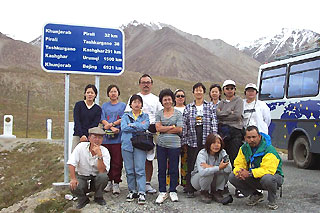
Karakoram Pass at the border China/PakistanWe were a group of 4 men and 10 ladies. Most groups cover only on one side of the route i.e. either China (Urumqi, Turpan, Danhuang) or Pakistan (up to KKH), bypassing the most interesting area of Kashgar and its world famous Sunday market. Kashgar was the meet point of the Silk route and its from here, ancient traders branched off to Pakistan India and China. We did both sectors.
This trip involved long journeys which taxes one's tolerance and endurance. But its the majestic scenery and cultural diversity that one experiences along the route makes it all worthwhile. It was also fortunate we went in August because the Karakoram Pass was closed to foreigners in September because of the Afghan War.

Day 1 Lahore: We boarded the Monday night flight and arrived in Lahore at 525pm. After a quick shower we took the local taxis to the busy "Food Street" a haven of outdoor eateries serving a great variety of sumptous food. Despite our long flight we were still alert to the sights and scents of this favourite haunt of the locals.
Day 2 Lahore to Rawalpindi: After breakfast we visited Lahore's Lahore Fort and the Badshahi Mosque with a walkabout in the Old City Bazaar with its narrow streets and interesting shops. We lunched at a upmarket restaurant known simply as The Village which offered a buffet spread with food from all over Pakistan. Then it was off to Rawalpindi arriving late evening. We just had time for a quick dinner before retiring for the night.
Day 3 Islamabad to Urumqi: Our flight to China left at 1100am and we flew over the Himalayan mountain range with its spectacular scenery. We arrived in China at 445pm local time. As quickly as we could, we settled in and then proceeded to the nearly Erdaoqiao Market or Ethnic Market. Dinner comprised of local meats and noodles. After browsing about the markets selling fruits, freshly baked breads, dried nuts and numerous handicrafted good, we retired to our hotel.
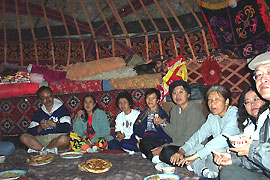
Day 4: Tianchi Lake: Today we departed for Tianchi Lake, a short 2.5 hrs bus ride for a 2 day stay in a Mongolian tent or yurt. This is also known as the Swiss Alps of China and a very popular destination. Unfortunately most visitors see only the fringes on their one-day excursion from Urumqi. Some of us visited the village while others did a walkabout along the fringes of the lake. All 14 members squeezed into the large yurt which also doubled up as the dining room.
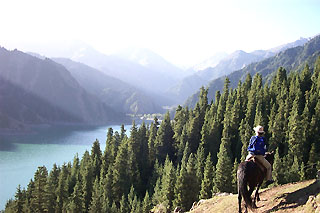
Day 5 Horsing about at Tianchi Lake, lamb's balls & penis dinner: Today most of us went on a full day trek on horseback with the intention of reaching the snowline. Unfortunately progress was slow and we opted to relax beside the river in a picturesque valley. We trekked up to a high mountain pasture land which was taken care of by only one family. I had my first taste of horse mare's milk, yogurt and cheese, offered by the friendly Kazakhs. For many in the group, it was the first time they went on a long horse ride and even I finished the day with sore buttocks. At night we had a extravagant Mongolian meal which included lamb's penis and testicles, a local favourite.
Day 6 Back to Urumqi for rest perhaps? After early breakfast, we headed back to Urmqi. The group were left on their own to to wander about this provincial capital of Xinjiang. It seems that one group had so much stamina that they only returned to the hotel was past midnight. I took it a little easier by resting at the Park watching the summer crowd "lepaking".
Day 7 Turpan - China's Grape Capital: Our first stop on the way to Turpan was the Wind Turbines Area which is the second largest wind generated electric facilty in the world, after California. Then is was a short stop in Dai Ban City, made famous by its mention in certain Chinese Classic novels. We visited a Karez well which is an ancient underground irrigation system for this desert area. Then it was off to the ancient city ruins of Jiaohe and Gaochang. I recorded temperature of 44 degrees C in Jiaohe.
Day 8 near Turpan - the Grape Valley: We went to the much-visited Grape Valley and spend a fair amount of time walking about the grape trellises. Turpan grapes are famous all over China and the varieties of grapes and raisins are astounding. August is a great time to visit because the grapes are in season. We headed back to Turpan where we had a half day, free to do our own sightseeing.
Day 9 Korla then Lunan not Luntai: We began this long journey of 510kms early and stopped over at Korla for a short ride on Bosten Lake, the largest freshwater lake in China. Then it was off to Lun An which is a non-descript town at the beginning of the Taklamakan Desert, with poor facilities. The journey was uneventful but some of us, especially the ladies, had "fun" bathing in doorless cubicles in Lunan.
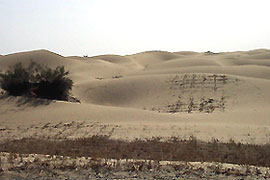
Day 10 Cross to Taklamakan Desert to Minfeng: One of the highlights of the trip is this 530kms journey on the new Desert Highway accross the second largest desert in China after the Gobi. The scenery was breath-taking with its vast areas of dunes. Taklamakan means "Once in, never out" in local Uigur. There's only one town, right smack in the middle of the Desert which was also our lunch stop. We arrived in Minfeng at about 6pm after this long tiring day.

Day 11 Hotan Carpets & Silk: Hotan is a short 290kms 4hrs away and produces some of the finest carpets in China. Carpets made in Hotan were found in the palaces of the emperors of China in Beijing. We visited a Government-run carpet weaving and silk weaving factories. Most of the work is done by hand, just like the olden days. We then rested at a large orchard which houses the oldest (80yrs) and biggest fig tree in the world.
Day 12 Finally, Kashgar !! The journey to Kashgar 520 km 8 hrs passes through quaint villages with its rows of poplar trees and donkey carts, which are the main form of local transport of people and goods. The diversity of people is a delight. We stopped in Yensigar for lunch and a bit of knife shopping. This town makes the best knives in Xinjiang. We arrived in Kashgar in the late evening and had a little bit of time to walk to the nearby market. The town which I visited in 1982 has grown probably five fold and has a typical 8 lane main road cutting through the town centre.
Day 13 Biking about Kashgar: We bicycled to Abakh Hoja Tomb aka the Fragrant Concubine's Tomb outside of Kashgar with a detour to visit the homes of local Uigurs. Later its more cycling to the other sights in Kashgar including the Id Kah Mosque and its adjoining bazaar. Those in the group who have higher energy levels also visited other Muslim tombs.
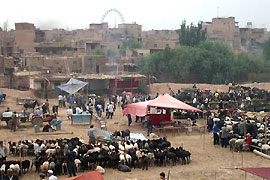
Day 14 Sunday Kashgar: We took taxis to the Sunday Market 2kms, which is a visual feast of the diverse cultures and people of Central Asia, dressed in their best clothes. The animal market and the traders are still the same from my visit in 1982 but the infractructures are better with proper shelters and tarred road. The other thing which has not changed is the escorted rich Western tourists in their outdoor clothes and expensive cameras.
Day 15 Upal surprise, poor Karakul Lake: The morning was wasted because our bus driver did not arrange the bus documentation earlier. So we started late and we broke the journey in the town on Upal. This turned out to be a blessing in disguise because it had a Monday market which was reminiscence of old Kashgar's. We were the only tourist walking around. Despite the numerous photo stops, we arrived in Karakul Lake at about 5pm. I had a bad time with the locals who were trying a con job. I finally managed to sort matters out and spent the night in a nearby Kyrgz yurt. This 3,700 meters high lake is beautiful but is ruined by greedy touts. We also managed a walkabout to a nearby river, trekking though some beautiful pastoral landscapes.
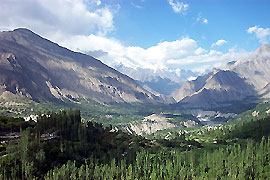
Day 16 Tashkurgan, Over the Khunjerab Pass to Sust/Passu, then to Karimabad: This was a long day of travelling. We lunched in Tashkorgan and due to non-communication by our inept driver, we almost missed the time to cross into Pakistan. We finally reached the highest highway in the world at 4730m at about 3pm Pakistan time. The high mountain scenery was majestic and on this day there were some 30 buses crossing into Pakistan. My Pakistan contact met us in Sust and we proceeded to Karimabad 52kms 1hr. Enroute we stopped at a popular viewpoint to admire and photograph the beautiful valley and the mountain spires know as the Passu Catheralls. We arrived late in Karimbad and everyone of us was exhausted.
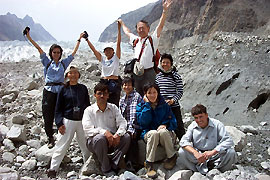
Day 17 Karimabad, Passu for Glacial trekking then back to Karimabad: In the morning we headed back towards Karimabad for a trek to the Passu Glacier, which is one of the most accessible glacier in Northern Pakistan. It was a pleasant walk with great views of the valleys and surrounding mountains. We also walked accross a 200 meters long cable suspension bridge. It was a windy day which made the event rather risky but all enjoyed it after they were safely back on firm ground. Then it was more photo stops and more picturesque viewing before we returned to Karimabad.

Day 18 Nagar Valley & Hoper Glacier by Jeep: This whole day trip is a popular activity for tourists. We squeezed five to a small jeep and travelled along narrow dirt roads to the village of Nagar. This good sized mountain village is richly cultivated and is the base of a trek "down" to Hoper Glacier. It was like being in a giant freezer on Hoper and it was more photographs. All in all, a very nice relaxing day.
Day 19 Gilgit, mango juice and water channel walks: Gilgit is 98kms 3 hrs away and we were settled in before lunch. We had cups of wonderfully prepared mango juice before setting off for an afternoon walk along the water channels in the Gilgit valley. These ancient waterways bring water from the glaciers miles away to the orchards and agricultural fields and are cut out of solid rock, some of which are located high up on the mountain sides.
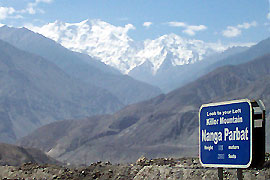
Day 20 Besham - a midway uneventful town: Our next stop was Besham 370kms 9hrs which is midway between Gilgit & Islamabad. The long journey is very scenic and we stopped at several established spots for views of the Nanga Parbat, Chilas/Shatial rock carvings, Indus river, among others. Thousands of Buddhist carvings are found in this area. Buddhism did not exist in China when this area was a centre for Buddhism.
Day 21 Taxila Buddhist Centre, Islamabad book street and more mango juice: On the way to Islamabad 270kms 6hrs we travelled along the Indus river and stopped to see the Ashoka rock inscriptions and Taxila, which was once a sprawling center for Buddhism. We also dropped by Islamabad's Sunday book street, selling a range of books at bargain prices. The delicious mango juices are also found here.
Day 22 Rawal Fort, Salt Mines & Lahore: Our last day in Pakistan was spent at nearby Rawal Fort. Many such Mogul forts are found all over Pakistan and Northern India. Then it was off to the Khewra Salt Mine, sited on the second largest in the world. This little known and seldom visited place is interesting and includes a small mosque made out of salt bricks. We were then rushed to the airport which was still some 2 hours away and made it with little time to spare. We flew home at 630pm.
Day 23 After a night on the plane, we arrived in Singapore then KLIA at 9am.
Horse trekking in Tianchi mountains| Home |