| Home | More Pictures |
23-days China to Pakistan Old Silk Route (19 Aug - 10 Sep 2004)
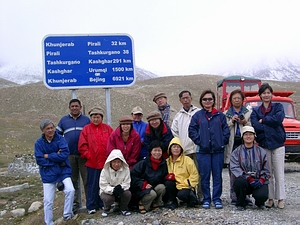
Karakoram Pass at the border China/PakistanWe were a group of 4 men and 11 ladies. Most groups cover only on one side of the route i.e. either China (Urumqi, Turpan, Danhuang) or Pakistan (up to KKH), bypassing the most interesting area of Kashgar and its world famous Sunday market. Kashgar was the meet point of the Silk route and its from here, ancient traders branched off to Pakistan India and China. We did both sectors. This trip involved long journeys which taxes one's tolerance and endurance. But its the majestic scenery and cultural diversity that one experiences along the route makes it all worthwhile.

Day 1 KLIA: We flew off on Thursday via Bangkok and arrived in Lahore at 11pm. After a quick checkin we proceeded to the busy "Food Street" a haven of outdoor eateries serving a great variety of sumptous food. Despite our long flight we were still alert to the sights and scents of this favourite haunt of the locals.
Day 2 Lahore to Rawalpindi: In the morning we visited Lahore's Lahore Fort and the Badshahi Mosque, followed by a drive around Lahore. Later we lunched at a upmarket restaurant known simply as The Village which offered a buffet spread with food from all over Pakistan. Midway on the route to Islamabad 270kms 6hrs we stopped at Khewera Salt Mine, reputed to be the second largest in the world.
Day 3 Islamabad to Besham: The main attraction near Islamabad are the Taxila Buddhist Centre. This UNESCO listed site was once a sprawling center for Buddhism, long before it reached China. Thousands of Buddhist sculptures can be found here. The rest of the 270kms 6hrs journey to Besham was punctuated by frequent photo-taking stops.
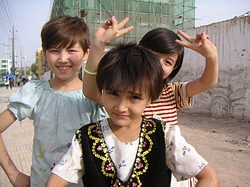
Day 4 Besham to Gilgit: In the morning we went for a walk around small-town Besham and mingled with the locals. Children make good photo subjects. It was another 370kms 9hrs bus ride to Gilgit, once again with frequent photo stops, including popular viewpoints of Nanga Parbat, the 8th highest mountain in the world. The scenery now is more rocky with sparse vegetation and greenery.
Day 5 Water Channels & Good Eating: We walked about this provincial capital of the Northern Territory in the morning and there's lots to see. After lunch we bussed to a nearby village for an evening walk on the scenic and ancient water channels. These are still in use to bring water down from the glacier mountains.
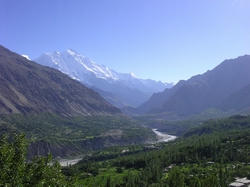
Day 6 Karimabad: Its 98kms 3hrs from Gilgit and the road passes through high mountain ranges. We passed pockets of crops where water was made available but most of the terrain were barren. On arrival we proceeded to the Baltit Fort, another UNESCO site, which also has great views of the Hunza valley. We spend the rest of the day exploring this pretty little mountain village and its surrounds.
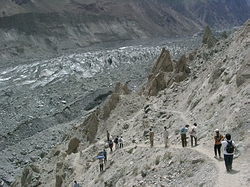
Day 7 Hopa Glacier & Nagar Valley: We squeezed five to a small jeep and travelled along narrow dirt mountain roads to the village of Nagar. This good sized village is richly cultivated and from here, we trekked "down" to the Hopa Glacier, which was like being in a giant refrigerator. Although the walk down was easy, getting back up was not.
Day 8 Passu Glacier & Gulmit: We left Karimabad for Passu 45kms 1hr and went on another glacier trek. The trek up the glacier took us about 1.5hrs one way. This is touted as one of the most accessible glacier in Northern Pakistan that is located just next to the main road. Later we walked across a 200 meters long suspension bridge and mingled with the villagers in Gulmit.

Day 9 Border Crossing & Tashkurgan: We took a long time getting the formalities done at the border crossing in Sost. We said our goodbyes to our guide and driver before going into the Khunjerab National Park. We arrived at the top of Karakoram Highway 47340m at about 1pm but the weather was cold and windy. After crossing into China, we were on the Pamir Plateau up to the town of Tashkurgan. After getting our passport stamped, we boarded our Chinese bus and headed for Karakul Lake. The road conditions were very bad and we arrived late, tired and cold at our Yurts (tents).
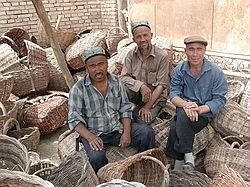
Day 10 Karakul & Kashgar: After breakfast, we visited the beautiful Lake Karakul 3700m with its brilliant blue waters. The half day trip to Kashgar was very scenic with high mountains and beautiful pastoral landscapes. We arrived in Kashgar at about 5pm but the sun sets at 10pm in Xinjiang. So we used the time and visited Kashgar Old City including the ancient Id Kah Mosque. The diversity of people and culture was a great experience.
Day 11 Kashgar Sunday Market: We hired donkey carts to take us to Abakh Hoja Tomb aka the Fragrant Concubine's Tomb outside of Kashgar, followed by a ride around the villages of the local Uigurs. We proceeded to the Sunday Market that has been in existence for hundreds of years. Its here that the Silk Road branched to India, Pakistan and the rest of China. We also enjoyed the wonderful spicy food of Xinjiang.
Day 12 Hotan: This long 520km took us longer than expected because of road upgrading that is expected to finish in about 2 years. The journey passed through numerous small villages and some good sized towns, with its usual fields of sunflowers, barley, maize and melons.
Day 13 Carpets & Minfeng: Hotan produces some of the best carpets in China which once decorated the palaces of the emperor of China. We visited a Government-run carpet and a white jade factory before making our way to Minfeng 290kms. This town is on the southern end of the Desert Highway.
Day 14 Taklamakan & Korla: This 530kms journey accross the Taklamakan (Once In Never Out) Desert is breathtaking with its vast areas of dunes. Its the second largest in China after the Gobi Desert and is said to have the highest reserves of oil and gas in China. Once we crossed the Desert, we headed off to Korla. We had an unexpected delay because our bus was stuck in the soft sands of a detoured road.
Day 15 Korla to Turpan: We spend the morning at the Korla local market which is devoid of any tourists. For many locals, we were the first Malaysians that they have met. Some of us shopped for CDs and VCDs. Korla is also famous in China for its pears. Of course we bought a couple of boxes. The journey to Turpan 510kms passed through more modern China with fields of agricultural produce and some food processing factories.
Day 16 Turpan: This grape capital of China is a popular tourist destination and the group went for a whole day tour visiting the Karez wells, Flaming Mountains, Gaochang and Jiaohe Ancient Cities. The rest of the evening was spend walking about Turpan and its town square to enjoy the sights and food.

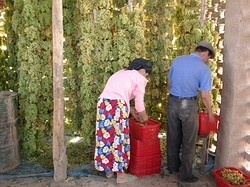
Day 17 Tianchi Lake: At the outskirts of Turpan, we stopped at a local village. This interesting detour gave us an opportunity to mingle with the friendly locals in the absence of any tourists. The were hanging grapes in their hot-houses for making grapes. We made our way to Tianchi Lake arriving at about 4pm. This is another very popular destination but fortunately most visitors come here on day-trips and remain on the southern fringe of the lake. We walked to the less visited viewpoints.
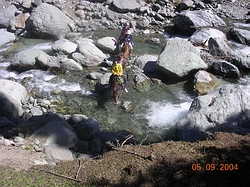
Day 18 Horsing in Tianchi: We went on a full day trek on horseback along the river which feeds Lake Tianchi. It was a relaxing pace with views of picturesque river, valleys and mountains. We left our horses near the snowline and trekked up to a high mountain pasture. All in all a very nice relaxing day. At night we feasted on lamb ala Mongolian style, including lamb penis and testicles.
Day 19: Urumqi: We arrive in Urumqi at 3pm and proceeded to the Erdaoqiao Ethnic Market. Across the road, there was a new shopping complex with Carrefour. The group was left to wander about this town to enjoy the sights and also the wide diversity of eateries.
Day 20 Urumqi: Today was a free-day. I visited a few outdoor shops. One group bought taichi equipment like clothing and swords. Urumqi is a huge city and capital of Xinjiang Autonomous Region. It has a good museum and a vibrant night market. Here, one finds a long stretch of food outlets and a longer stretch of stalls selling a wide range of products.
Day 21 Fly Islamabad: We flew from Urumqi in the morning and arrived in Islamabad 1130am. We lunched in town near our hotel and then walked the nearby town bazaar. In the evening, we went on a city tour finishing off at the second largest mosque in the world.
Day 22 Lahore: We drove to Lahore using the old road for a change. We stopped to visit the new Cultural Musuem and the older Lahore Musuem. We also viewed the closing of the Pakistan Indian border before adjorning to the Village Restaurant for our favourite buffet dinner. Our flight home was at 12pm.
Day 23 Home: Arrived home via Bangkok at 12am.

| Home |