
16 - 30OCT 2026 (15 days) Daocheng Yading & 317 route 稻城亚丁317线
Cost Rm8300 (12 pax group), RM8000 (14 pax group and above) (Excluded flight ticket )
Update 26 April 2026 -Daocheng Yading rated one of the most beautiful places in China, so called "Shangrila". On top of that, we also explore exoctic places called Dege, Yaqingshi, Baiyu at 317 route where still remote and yet to be discover the beauty of the nature of earth!. This is the BEST season to go. Please bear in mind that some stay is very basic and simple. Be prepare for 'unexpected' things turn out, otherwise have fun :-)
Please register and confirm your seat by email rachelheng123@gmail.com or whatsapp Rachel 012-3520868
IMPORTANT NOTICE: This is meant to be a "free and easy" adventure trip. Participants should be relatively fit, with a good sense of humor, and above all, have the right attitude for close travel with others through possibly some trying times. Most definitely, this is not a trip for prudes, whiners, fuss-pots, and other similarly assorted types! We had a couple of those before and it wasn't pleasant for us or them. Although every effort will be made to stick to the given itinerary, ground conditions may change and cause some disruption and/or deviation from the norm. Otherwise, have fun.
.jpeg)
Yading Park
Day 1 KL to Chengdu: Depart from KL to Chengdu; Check in hotel Free & Easy. ON Chengdu.
Day 2 Chengdu-Dujiangyan (50km 1hr) -Mt Siguniang (200km 3hr): Depart by vehicle for Mount Siguniang Town (3200m). En route, we will visit the Dujiangyan Irrigation System. Built in 256 BC, it is the world’s oldest and only surviving grand water conservancy project characterized by its damless water diversion design.
The project primarily consists of three functional parts: the Fish Mouth Levee (water-splitting dike), the Flying Sand Weir (spillway), and the Baozhikou Inlet (precious bottle neck). This ingenious system scientifically automates river diversion, sediment discharge, and water flow control. By eliminating the threat of flooding, it transformed the Western Sichuan Plain into the "Land of Abundance," a region where "droughts and floods are managed at the will of man."
After lunch, we will continue our journey to Mount Siguniang Town to check into our hotel and rest. O/N Siguniang Town.
Day 3 Mt Siguniang Exploration : After breakfast, we enter Changping Valley, a stunning "green corridor" stretching 29 kilometers. This valley is home to 21 scenic spots, including the Lama Temple, Withered Tree Beach, Jiarongdu Waterfall, Muluozi (Wooden Mule) Meadow, and views of the majestic Pomiu and Camel Peaks.
The landscape here transforms with the seasons: spring brings blooming alpine flowers, summer showcases ancient, weathered forests, autumn is painted with vibrant red birches and maples, and winter offers a serene view of snow-capped peaks. Beyond its natural beauty, the valley is steeped in the mystical legends of Mount Siguniang and the rich, thousands-year-old ethnic customs of the Gyarong (Jiarong) Tibetans.
Changping Valley is the premier destination for experiencing both the primitive ecology and the cultural heritage of the region. We will take an electric shuttle from the entrance to the Lama Temple, followed by a 7-kilometer trek or a horseback ride to fully immerse ourselves in the scenery. O/N Siguniang Town.
Day 4 Siguniang Town-Jiaju Tibetan Village-Danba County (115km 3hr) : The Mount Siguniang scenic area is primarily composed of three valleys: Shuangqiao, Changping, and Haizi. While Changping and Haizi are preferred for trekking, Shuangqiao Valley is the most well-developed and accessible. The mountain massif itself consists of four distinct peaks: Grand Peak, Second Peak, Third Peak, and the majestic Yaomei Peak.
Today, we will focus our exploration on Shuangqiao Valley. The landscape here is a picturesque blend of alpine pastures, winding rivers, forested boardwalks, and views of over a dozen snow-capped peaks exceeding 4,000 meters.
After lunch, we will drive through the Xiaojin River Valley to Danba County (1900m), famously known as the "Kingdom of a Thousand Watchtowers." Our final destination is Jiaju Tibetan Village, an idyllic sanctuary often described as a "Tibetan Fairy Tale World." In the local dialect, "Jiaju" translates to "a hundred households." The village cascades from the banks of the Great Jin Valley up to the foothills of the Kapamar Peaks. Stretching across a vertical drop of nearly 1,000 meters, the traditional stone dwellings are beautifully scattered among lush greenery along the undulating mountainside.
O/N Danba.
.jpeg)
.jpeg)
Day 5: Danba – Yala Snow Mt Viewpoint-Tagong Grassland (3400m) After breakfast, we will travel along the Yak River, passing through the "Natural Bonsai" scenery of the Donggu Valley, to arrive at the Yala Snow Mountain Viewpoint. In Tibetan, the mountain is known as "Xiaxue Yala Gabor," meaning "The Eastern White Yak Mountain." As we cross the Geda Liangzi Pass, we will enjoy sweeping landscapes before arriving at Tagong (a name meaning "A place where the gods do not want to leave"). Here, in the heart of the scenic area, you will stand face-to-face with the magnificent snow peaks at an incredibly close distance.
We will take a leisurely stroll along the forest boardwalks of the Yara Valley, nestled amidst pristine woodlands. Afterward, we visit the Tagong Grassland, a signature highland meadow of the Tibetan region, and enter the Muya Grand Temple. Known as "Little Seda" for its striking crimson architecture, the temple offers a profound spiritual atmosphere.
As a special cultural activity, we will visit a master of the Six-Character Mantra stone carvings. Together, we will participate in the traditional art of Mani stone painting. Guided by local elders, we will ascend the Mandala (altar city)—a structure composed of hundreds of millions of Tibetan characters carved into stone—where we will place our custom-made Mani stones to offer prayers and blessings. We will conclude the day at our hotel on the Tagong Grassland, witnessing the breathtaking "Golden Mountain" (sunlight illuminating the peaks) at sunset. O/N Tagong town.
.jpeg)
.jpeg)
Tibetan Monastery
Day 6: Tagong -Moshi Park- Dawu Tibetan Houses (110km 2hr) : After breakfast, we will explore Moshi Park (Stone Forest), a geological wonder primarily composed of mylonite. Experts often refer to this site as the "Bermuda of Geology." It is the only plateau stone forest landscape in China and is celebrated as the "8th Beauty of the Chinese National Geography Scenic Highway." To truly experience its charm, we will ascend to the observation deck. From there, you will witness a spectacular vista of countless jagged peaks and towering stone pagodas—a surreal, monochromatic landscape that is truly unforgettable.
Afterward, we depart for Dawu (Daofu) to visit the famous Dawu Folk Houses, locally known as "Bengke." These structures utilize whole logs as a sturdy framework with walls built of mud or stone. The "Bengke" design is exceptionally durable and earthquake-resistant. Architecturally, these houses are elegant and refined, featuring distinctive white and red exterior walls, intricately carved colorful windows, and "triple-layered" eaves. You will also notice small incense altars on the balcony walls and prayer flag towers atop the roofs.
For a unique cultural immersion, we have arranged a Tibetan Afternoon Tea inside a traditional Dawu residence. You will have the opportunity to sample authentic yak butter tea paired with a selection of local Tibetan snacks and pastries. O/N Dawu (3300m)
.jpeg)
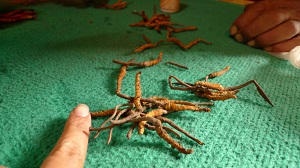
Moshi Park/Cordyceps 冬虫夏草
Day 7: Dawu -Lake Kasa -King Gesar - Garze (168km 3km):
In the morning, we depart for Garze (Ganzi). En route, we will visit Lake Kasa, a stunning alpine lake cradled by mountains on three sides. Its vast, deep waters resemble a massive rectangular mirror reflecting the sky. The lake is a thriving sanctuary for wildlife; you can watch pairs of yellow ducks gliding across the surface, creating gentle ripples. Beneath the water, lush aquatic plants provide a rich habitat for fish and crustaceans. The surrounding high-mountain meadows are naturally adorned with vibrant wildflowers, with the silhouettes of nearby temples and mountain peaks casting beautiful reflections upon the lake.
.jpeg)
In the afternoon, we arrive at the King Gesar Tibetan City. Built upon the historical site of the "Great War of Huo and Ling" from the Epic of King Gesar, the city is divided into four main areas: the Gesar Cultural Zone, Wetland Leisure Zone, Grassland Experience Zone, and Epic Sightseeing Zone.
The city is a magnificent tribute to Tibetan heritage, featuring a grand main boulevard and a central royal palace. It meticulously traces the legendary life of King Gesar, creating a comprehensive chronological narrative and a three-dimensional cultural masterpiece. As a new landmark for cultural tourism, it offers the most concentrated display of Gesar culture and the most diverse array of traditional Tibetan architectural styles in the region. We will enjoy the spectacular night view of the city before retiring to our hotel. O/N Garze.
Day 8: Garze -Gan Bai Road- Yarchen Gar-Baiyu (220km 4hr) : In the morning, we depart for Baiyu County via the Gan-Bai Road, widely considered one of the most beautiful scenic routes in the region. Stretching approximately 220 kilometers from Garze to Baiyu, this journey offers an incredible diversity of landscapes, including snow-capped peaks, sprawling glaciers, alpine meadows, and pristine forests.
Along the way, we will cross the Zhuodala Mountain Pass, catch glimpses of the ancient glacial landforms of Mount Haizi, traverse the vast Ritongba Grassland, and wind through the forested river valleys of the Chaqingsongduo Nature Reserve.
In the afternoon, we visit Yarchen Gar (Yaquing Temple). This monastery is home to over 20,000 practitioners and is uniquely dedicated to the spiritual training of female monastics (Jumu or nuns). It currently holds the largest concentration of Buddhist nuns in the world. The Qu River encircles a small island that serves as the primary living quarters for the nuns; this sacred enclave is known as the "Kingdom of Female Buddhas," a place said to be closest to the heart of the Buddha. O/N Baiyu.
.jpeg)
Day 9: Baiyu-Cuopugou Scenic Area (160km 3hr) :
In the morning, we depart for Cuopugou (3200m). Following lunch, we will explore this "hidden paradise," a secluded sanctuary in the Western Sichuan Highlands that integrates snow-capped mountains, sacred lakes, virgin forests, river canyons, hot spring waterfalls, and diverse wildlife.
The centerpiece of the area is Lake Cuopu, which is revered as the "Number One Sacred Lake of Kham." While the Batang region is home to over a hundred lakes of various shapes and colors, Lake Cuopu is undoubtedly the most beautiful, with waters as vibrant and clear as turquoise.
The lake is cradled by mountains on all sides: to one side stands the rugged and uniquely shaped Zhajin Jiabo Sacred Mountain, with its sheer cliffs and exposed rock faces. To the front rises the 5,833-meter Nite Gangri Peak. The entire lake is surrounded by lush forests and emerald-green slopes. The scenery here is elegant and serene, with the shimmering, crystal-clear waters resting peacefully under the brilliant highland sun. We will spend the night at a local homestay within Cuopugou to fully soak in the tranquility. O/N Cuopugou.
Day 10: Cuopugou -Litang (120km 2hr) -Daocheng-Yading Vilage (258km 4hr) : In the morning, we depart for Litang (4000m)to visit the Litang Monastery (also known as Ke’er Monastery). Founded in 1540, it is one of the most iconic temples in Litang. Originally a temple of the Bön (Black) sect, it was expanded over centuries into the largest Gelug (Yellow Hat) monastery in southern Kham, earning the title "Sacred Buddhist Land of Southern Kham." The temple complex cascades up the hillside in a staggered, multi-layered design. The main halls and monk residences are positioned at the highest points; as you ascend the steps toward these majestic structures, you will experience a profound sense of spiritual transcendence reaching toward the heavens.
We will then explore the Thousand-Household Tibetan Village, the largest collection of Tibetan dwellings in China, comprising 13 villages and over 4,000 traditional houses. Within this cultural cluster, we will visit:
- Renkang Ancient House: A historic residence with over 400 years of history and the birthplace of the 7th Dalai Lama.
- Tsangyang Manor: An exquisite traditional restaurant themed around Tibetan culture.
- Himalayan Sound Micro-Museum: A space to experience the unique ethnic and religious musical heritage.
- Khampa Museum: The first wax museum in the Tibetan region.
- Thematic Cultural Museums: Several small museums showcasing Tibetan calligraphy, Thangka painting, and stone carving.
After our cultural tour, we will continue our journey to Shangri-La Town (Yading) (2800m) to check into our accommodations in Yading Village. O/N Yading.
Day 11: Yading Nature Reserve (4600m) :
From the park entrance, we will take a sightseeing bus directly to Zhaduan崩 (Zhaduanbang). After a short 10-minute walk, we arrive at the Chonggu Meadow, where we will board an electric eco-shuttle to reach the Luorong Cattle Farm.
Luorong Cattle Farm is a vast, golden alpine meadow framed by the towering presence of the three sacred mountains—an unparalleled vantage point for mountain photography. Both the Chonggu Meadow and Luorong Cattle Farm gained additional fame as iconic filming locations for the movie "Belonged to You." Here, we will also visit the historic Chonggu Temple and pay our respects to the north peak, Xiannairi (the "Merciful" peak).
The three sacred peaks—Xiannairi, Yangmaiyong, and Xianuoduoji—are revered as the "Soul of Shangri-La" and represent the spiritual heart of the Yading Scenic Area.
Depending on your physical condition and energy levels, you may choose to embark on a more challenging trek to Milk Lake and Five-Color Lake. This section can be navigated on foot or by hiring a horse; the round-trip hike typically takes 5 to 7 hours. Afterward, we will descend and return to Shangri-La Town for the night. O/N Yading.
.jpeg)
.jpeg)
Day 12: Shangri-la town- Litang - Yajiang - Xinduqiao (428km 7hr) : In the morning, we will visit Chonggu Temple and Pearl Sea (Zhuoma La-tso). Located near the temple, Pearl Sea is the lowest-altitude lake in the Yading Scenic Area. Its waters are as green as emerald and crystal clear, surrounded by lush trees and pleasant scenery. It is world-renowned as the premier spot for capturing the perfect reflection of the sacred Mount Xiannairi.
After lunch, we begin our scenic drive back toward Xinduqiao. We will cross a series of majestic mountain passes, including Mount Bowa (4,513m) and Mount Haizi (4,600m), before passing through Litang (4,010m), the "World's Highest City." Our journey continues over the Kazila Mountain Pass (4,718m) to the mountain-side town of Yajiang.
Finally, we cross Gao'ersi Mountain to arrive in Xinduqiao (3400m), famously known as the "Photographer’s Paradise." Along the way, you will enjoy the magnificent scenery of the eastern Qinghai-Tibet Plateau, including snow peaks, alpine forests, and seas of clouds. If the weather is clear, you will have the opportunity to photograph the rolling snow peaks of Mount Gongga (Minya Konka)—the highest peak in Sichuan, known as the "King of Sichuan Mountains." We will then check into our hotel for a well-deserved rest.
.jpeg)
Day 13: Xinduqiao - Jiagenba Village- Zheduo Mt-Liuliu Old street-Kangding (75km 1hr) : After breakfast, we depart for Jiagenba. While the beauty of Xinduqiao is best experienced along National Highway 248, Jiagenba is widely considered the most spectacular section of that route! Qika Village, the heart of Jiagenba, is an essential part of the "Photographer’s Paradise." With its towering ancient trees, idyllic pastoral landscapes, and perfect natural lighting, it offers a harmonious vision of "Shangri-La" where culture and nature blend seamlessly.
Next, we head toward Kangding, crossing the legendary Zheduo Mountain. As part of the Great Snowy Mountains (Daxue Shan), this pass serves as a vital geographical boundary: to the west lies the vast Yalong River plateau, while to the east are the deep gorges of the Dadu River. With a vertical drop of 1,800 meters down to Kangding city, it is the first major high-altitude pass on the Sichuan-Tibet Highway, earning it the title "The First Gateway to Kham."
We arrive in Kangding (2500m) in the afternoon. Known worldwide as the "Hometown of Love Songs," this city is the birthplace of the Kangding Love Song, a melody that has given the town a romantic and soulful identity. Historically referred to as the "Throat of Western Sichuan" and a "Key Town on the Ancient Tea-Horse Road," Kangding has long been a pivotal center for trade and cultural exchange between Han and Tibetan peoples. Today, it continues to draw travelers with its rich history and the enduring charm of its musical heritage. O/N Kangding.
.jpeg)
Day 14: Kangding -Luding Bridge-Chengdu (280km 4hr) :
In the morning, we depart for Chengdu. En route, we will pass through Luding County to visit the historic Luding Bridge. Spanning the roaring Dadu River, this iron-chain suspension bridge stretches 103.67 meters and is constructed from 13 massive iron chains. The bridge gained international fame for the legendary "Flying Seizure of Luding Bridge," a pivotal battle during the Red Army's Long March.
The bridge was completed in April 1706 during the 45th year of the reign of Emperor Kangxi of the Qing Dynasty, marking it as the first bridge ever built over the Dadu River. The Emperor himself bestowed the name "Luding Bridge"—combining "Lu" (referring to the river) and "Ding" (signifying the stabilization of the region). He personally inscribed the bridge’s name on a stone stele that still stands at the bridgehead today. Since its completion, Luding Bridge has served as a vital link for trade and transportation between the Tibetan and Han regions.
After the visit, we continue our drive to Chengdu. Upon arrival, the rest of the day is yours to enjoy at your leisure. O/N Chengdu.
Day 15 : Fly Home : Fly home.
TERMS AND CONDITIONS
- Cost covered accommodations, transportation, local guide.. Accommodations will be in budget hotels and guesthouses. Airport transfers and inter-town travel by chartered bus are covered.
- Not covered are flight ticket KL-Chengdu-KL (appx RM1600-2000 ), visa fees (waive for Malaysian/Singaporean 30days), meals (Rm60 x 10 days = Rm600) and entrance fees (approximately Rm650). Note that entrance fees are HIGH in China, some which are mentioned in the itinerary above.
- Note we do not collect up front compulsory tips nor do we bring our groups for "compulsory" shopping stops. Members will decide the tips based on their satisfaction of the guide services.
- Cost is subject to change depending on fluctuations in exchange rates and/or airfares.
- Non-refundable deposit of Rm2500 will be payable to confirm your place.
Email: rachelheng123@gmail.com
Phone: Rachel 012 352 0868
| Home |.