
| Home | Link to 100 photos |
YONGO SHORTIES OR ANYTIME TRIP - if these dates are not suitable or if you have your own group, do let us know. We can do these short trips anytime as long as our associates are available to lead.
Mar 1 – 7, 2008 (7-days) Beijing & Chende Historical Exploration
Cost Rm2300 (per pax for group of min 10 pax), Rm2200 (group of 11 up to max 16 pax)
Mar 21 - 27, 2008 (7-days) Beijing & Chende Historical Exploration
Cost Rm2500 (per pax for group of min 10 pax), Rm2400 (group of 11 up to max 16 pax)
Update 13 Jan 2008 - Please contact Simon +6016-7110672 or Rachel 012 352 0868 for this trip. 1st departure is priced lower because of low season airfares. Trip will be led by Simon, Yongo's new assocaite, who is passionate about Beijing.
IMPORTANT NOTICE
some trying times. Most definitely, this is not a trip for prudes, whiners, fuss-pots, and other similiarly assorted types! We had a couple of those before and it wasn't pleasant for us or them. Although every effort will be made to stick to the given itinerary, ground conditions may change and cause some disruption and/or deviation from the norm. Otherwise, have fun. This is meant to be a "free and easy" adventure trip. Participants should be relatively fit, with a good sense of humour, and above all, have the right attitude for close travel with others through possibly
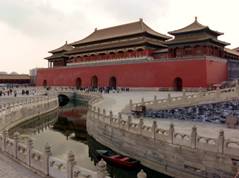
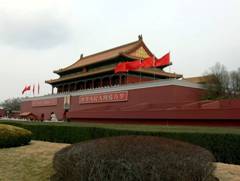
Forbidden City
This will be a backpack experience using public buses/subways/taxis. Its important participants are able to manage their own luggage and backpacks are recommended. As usual, you pay for your own meals unless stated below, entrance fees, within-the-town taxis and other activities.
Beijing as host of the 2008 Olympic Games is a fascinating time to visit especially before the games. Beijing has been at the center of China's cultural and political life for seven centuries. The city gained its prominence in the 13th century AD when it was established by Mongol ruler Kublai Khan as capital of the Yuan Dynasty. However, it wasn't until Ming Dynasty ruler Yongle (1403-1425) showed up that the prominent landmarks of today's Beijing made the scene. Yongle leveled all Yuan Dynasty buildings, determined to erase all traces of Mongol rule over China, and initiated construction of the Forbidden City and the Temple of Heaven. Yongle also gave the city a new name: Beijing (Northern Capital).
Besides Forbidden City and Temple of Heaven, Beijing has many things to offer. Hutong as an old quarters for hundreds years, Great wall, Summer Palace, Beihai Park and its new business centric area for shopping – Huang Fu Jing Street. Beijing also hold a numerous World Unesco Heritage side and you will be fascinated to visit those places. Moreover these areas are located quite near to each othe
Day 1 KLIA: Assemble at KLIA at 9PM for mid-night flight.
Day 2 Forbidden City & Jing Shan: Arrive Beijing at the morning, transport by airport bus and taxis to our hotel hotel. Take a short rest then we visit The Forbidden City. The world's largest palace complex, the Forbidden City (Gugong or Zijincheng) covers 720,000 square meters. Hall of Supreme Harmony (it's China's largest wooden structure). This was a key site for the imperial court, where the highest-level official business took place, including ceremonies like the enthronement of the Crown Prince, the Emperor's birthday celebration and imperial marriages. The hall is decorated with thousands of dragons, a traditional symbol of imperial power. Finally, the Imperial Gardens lie beyond the Inner Court buildings, consisting of exquisitely landscaped grounds and more important structures, including the Hall of Mental Cultivation and the Palace of Tranquil Longevity. A number of imperial artifacts are on view in various locations throughout the Forbidden City.
Jing Shan, located North side of Forbidden City, was previously Royal garden. This garden has more than 800 years old history. Ming Dynasty last emperor, Chung Zhen, hang himself over there after rebellion Lee Ji Chen conquer the Forbidden City. From top of this area, we could view the entire landscape of Forbidden City.
We expect to spend a fair amount of time exploring the Forbidden City until late afternoon. Then its free & easy to shopping area of Huang Fu Jing and to enjoy eating at the local eateries.
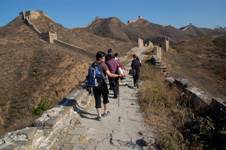
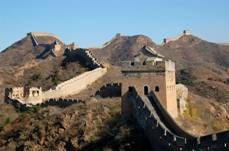
Trekking Great Wall Jinshaling to Simatai
Day 3 Simatai & JinShanling: After early breakfast, we will visit the Great wall at Jinshaling and Simatai. Construction of the wall first began more than 2500 years ago and has a total length of over 6000 kilometers. We start our Great Wall Walk at Jinshaling and the do the leisurely 4 to 5hr trail. One gets a better feel of the Great Wall here because of the lack of tourist hordes and many parts of the Great Wall are still "original" with shrubs and plenty of greenery. We finish the trek in Simatai after which the bus takes us back to Beijing.
Day 4 Temple of Heaven & BeiHai Park: We vist the Temple of Heaven ( Tiantan ), completed in 1420 during the reign of Ming Emperor Yongle. Originally served as the most sacred space in which the emperor (the Son of Heaven) would perform the most important sacrifices and rites. The gods of earth, water, war, and civilian affairs were all honored, but it was the god of agriculture who received special attention due to the importance of agriculture in China.
We also visit Beihai Park lies just to the west of the Forbidden City. Until 1925 it was considered part of the imperial complex and therefore off-limits to the masses. It's easy to spend the better part of a day on the 86-hectare (186 acre) park, strolling, relaxing, people-watching and visiting a number of exceptional sights: the Yuan-era Jade Jar of Dushan in Tuan Cheng (the Round City), the striking Tibetan White Dagoba, the Painted Gallery, the Nine Dragon Screen, Daxitian (Heavenly King Temple), the Liulige Tower, Yong'an Temple and the Five-Dragon Pavilion being among the most popular.
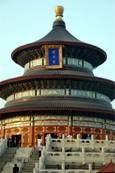
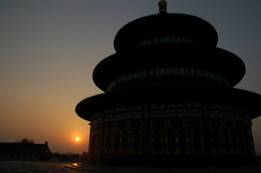
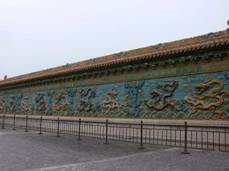
Temple of Heaven & 9 Dragon Wall at Bei Hai Park
Day 5 Imperial Summer Villa & Mountain Resort & Putuo Zongcheng Miao: We will leave to Chende in early morning after breakfast. Chengde is best known for Bishu Shanzhuang (also known as the Imperial Summer Villa and Mountain Resort), an imperial summer getaway for the Qing emperor and his court that grew to be larger than the Forbidden City and Summer Palace combined. The great Qing emperors Kangxi and Qianglong, responsible for the glory of Bishu Shanzhuang, used it not only for their own pleasure but as a way to symbolically bind together imperial China's far-flung and restive ethnic minorities. That means that Chengde's temples and Mountain Resort buildings include wonderful replicas of Tibet's Potala Palace and various Tibetan and Mongolian Lama temples, along with indigenous Manchurian-style buildings and gardens that imitate the fantastic landscapes of southern China.
Chengde's Putuo Zongcheng Miao (Temple of Potaraka Doctrine), dedicated to Emperor Qianlong on his birthday in 1771, is an astonishing copy of the traditional seat of Tibetan power. Like Puren Si (Temple of Universal Peace), Pule Si (Temple of Universal Happiness) and other Chengde edifices, it served as a symbol of the unifying power of the Qing Empire over a diversity of peoples and cultures. It is also reflective of the long-standing Chinese fascination with Tibetan Buddhism and Lamaism, which had a profound effect on China's own cultural development
Day 6 Summer Palace& Hutong: Today's Summer Palace (Yíhe Yuan or "Garden of Nurtured Harmony") owes a lot to late-imperial historical circumstance. Originally known as the "Garden of Clear Ripples," the site was established in 1750 by the Emperor Qianlong. the Summer Palace grounds are the largest preserved imperial-era garden in China, occupying some 117 hectares (290 acres). Once inside, a host of sights await exploration, from the Duobao Glazed Pagoda atop Longevity Hill, to the painting-lined Long Corridor, to the lake's Marble Boat and temple-dotted Nanhu Island, reached by the elegant Seventeen Arch Bridge.
After the visit of Summer Palace, we will proceed with exploring Beijing Ancient town, Hu Tong. Many of these charming alleyways remain,crisscrossing east west across the city and linking to creat a huge, enchanting warren of one storey, ramshackle dwellings and historic courtyard homes. We may even rent a bicycle to swamp the town.
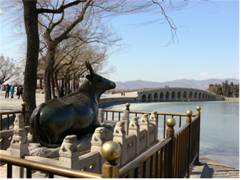
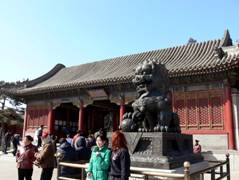
Summer Palace
Day 7 Fly Home: In the morning we are free and easy and catch the last minute shopping on your own time. Check Out and We transfer to the airport in the afternoon for the flight home.
TERMS AND CONDITIONS
- Cost cover airfares, accommodation and traveling to sites mentioned above.
- Cost excludes airport taxes & fuel surcharges (about Rm530), visa fees (Rm40), meals, entrance & activities fees and in-town taxis or bus on free days.
- We do not do compulsory shopping stops common to normal China tours nor do we collect compulsory up-front tips.
- Cost is subject to change depending on fluctuations in exchange rates and/or airfares.
- A deposit of Rm800 will be payable to confirm your place.
Email:rachelheng123@gmail.com or yongo@streamyx.com
Phone: Rachel Heng 012 352 0868 or Yong Lee Min: 016 220 9033 / 603 4023 8210
Mail: 19 Lorong Air Bersih Tiga, Air Panas, 53200 Kuala Lumpur
| Home |